
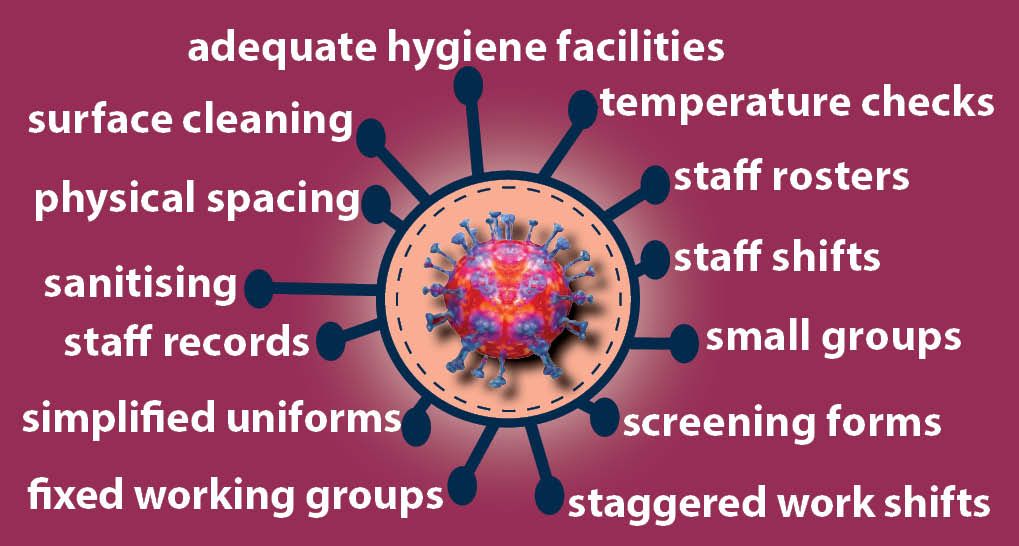
Staff areas are just as important for sanitising and physical spacing as public areas.
In order to manage staff teams, and address PPE requirements and allocation of staff to shifts, businesses should identify working areas and rank them as high, moderate and low risk areas based on the type of job/activities and levels of contact with guests and other staff.
At risk staff members, i.e., those who are older or have co-morbidity conditions, should be given special consideration. Rosters can be adjusted so older/compromised staff work in low risk areas, or on reduced shifts and there should be enhanced standard operating procedures for at risk workers including more PPE such as visors.
For accommodation establishments
Consideration can be given to having staff stay in hotels to avoid public transport risks. Rosters can also take into consideration staff travelling at non-peak times to reduce public transport risks.
Staff should be allocated to separate shifts or shift teams per area or function and changes to teams should be avoided. This allows for mitigation if a staff member tests positive, as only one staff team will be required to isolate.
Staff in teams should work, eat, and arrive separately so there is no cross-contamination between teams. Shifts may be staggered slightly (e.g., 10-minute intervals) to avoid queues at staff entrances and congestion in locker rooms/changing rooms, and to stagger mealtimes.
Locker/change room times should be scheduled to allow for smaller groups at any one time in the rooms. A similar increase in sanitising and surface cleaning in all staff areas as in public areas is required, plus the same schedules for completion to indicate sanitising has occurred. Any scanners – e.g., fingerprint scanners, clocking-in machines etc., must be wiped frequently as part of the surface-sanitising schedule or disabled.
Lockers need to be sanitised after each shift by each staff member before they leave. There must be adequate facilities for the washing of hands with soap and clean water and only paper towels should be provided in staff ablutions for drying hands.
Staff must hand sanitise or wash hands before and immediately after entering the work premises or vehicle, after changing into uniforms, after using lockers and frequently while on shift, particularly after touching items or surfaces.
Staff uniforms may be reduced in complexity and limited to simple items, for instance caps, scarves and ties can be omitted.
Correct uniform change and uniform laundry procedures must be followed. Staff who care for their own uniform or work clothes at home, need to be trained and assisted to sanitise uniforms correctly. If possible, it is preferable that uniforms be cleaned at an in-house or outsourced laundry, where they can be properly cleaned on deep high temperature cycles and steam press or heat ironed.
Staff kitchens, canteens, and bathrooms must be operated under the same hygiene, sanitising, and spacing standards as guest restaurants. Similarly, the same standards will apply to service elevators as guest elevators.
Staff arrival and screening
It is important to ensure that additional staff information is recorded and kept up to date including relevant medical history regarding chronic or other conditions and staff must be asked to inform HR/management if there are changes. It will be explained that these steps are for their own protection. Other staff information such as contact details, physical address, who they live with, next of kin etc., must be up to date.
On arrival staff must undergo a screening and sanitising process including spraying or wiping shoes, clothes, handbags, cell phones and face masks before or just after entry. Walk-off mats can also be implemented at entrances.
All staff members will have their temperature checked on arrival and before departing and answer screening questions or complete a screening form. The screening must ascertain whether they have any of the observable symptoms associated with COVID-19, namely fever, cough, sore throat, redness of eyes or shortness of breath (or difficulty in breathing).
Any staff transport vehicles must adhere to the same protocols as guest vehicles with respect to sanitising, cleaning, capacity, entry and exit, driver interaction etc.
Where outsourced workers are concerned, the outsource company must ensure similar staff records are kept and must ensure their staff follow all standard operating procedures. They must also assist in keeping the same staff on the same shift or team, and in identifying at risk workers for additional attention.
HR policies must be updated to reflect all the changes due to the COVID-19 operating environment.